

Essential Tremor vs. Intention Tremor: Key Differences
Most of us have felt our hands shake after a strong cup of coffee or a stressful moment. But when those tremors become a constant part of your life, they start to interfere with everyday tasks—from eating a meal to typing a text. To understand what is happening, you must distinguish between two conditions: essential and intention tremor. While both involve involuntary movements, they stem from different neurological causes and are triggered during different stages of activity. So, how can you tell which one is affecting your daily life?
Comparison: Essential vs. Intention Tremor
|
Feature |
Essential Tremor (ET) |
Intention Tremor |
|
Primary Trigger |
Occurs during posture or simple movement (action). |
Occurs specifically when nearing a target. |
|
Movement Pattern |
Rapid, rhythmic, and fine. |
Slower, coarser, and "zig-zag" like. |
|
Common Causes |
Genetics (hereditary), aging. |
Cerebellar damage (MS, stroke, injury). |
|
Body Parts |
Usually both hands; sometimes head or voice. |
Often affects one side; linked to coordination. |
|
Alcohol Effect |
Often temporarily improves with small amounts. |
Usually worsens symptoms. |
What Is Essential Tremor?
Essential tremor (ET) is the most common movement disorder. It causes involuntary, rhythmic shaking, usually in both hands and arms. It is most noticeable when you hold your limbs against gravity or perform tasks like drinking, using cutlery, or writing.
In everyday life, this might look like a fork that rattles as you lift it, a pen that "dances" across the page, or a cup that feels less steady than it used to. These tremors often intensify during periods of stress, anxiety, or fatigue. While caffeine can mimic or worsen shaking, ET is a distinct neurological condition. Interestingly, some individuals notice a temporary reduction in symptoms after consuming a small amount of alcohol, though this is not a recommended treatment.
While ET tends to affect the hands first, it can also involve the head (often a “yes-yes” or “no-no” movement), the voice, or, less commonly, the legs. Many people have a family history of similar shaking, and symptoms usually progress slowly over many years. Although it is not life-threatening, it can significantly impact your independence if left unmanaged.
What Is Intention Tremor?
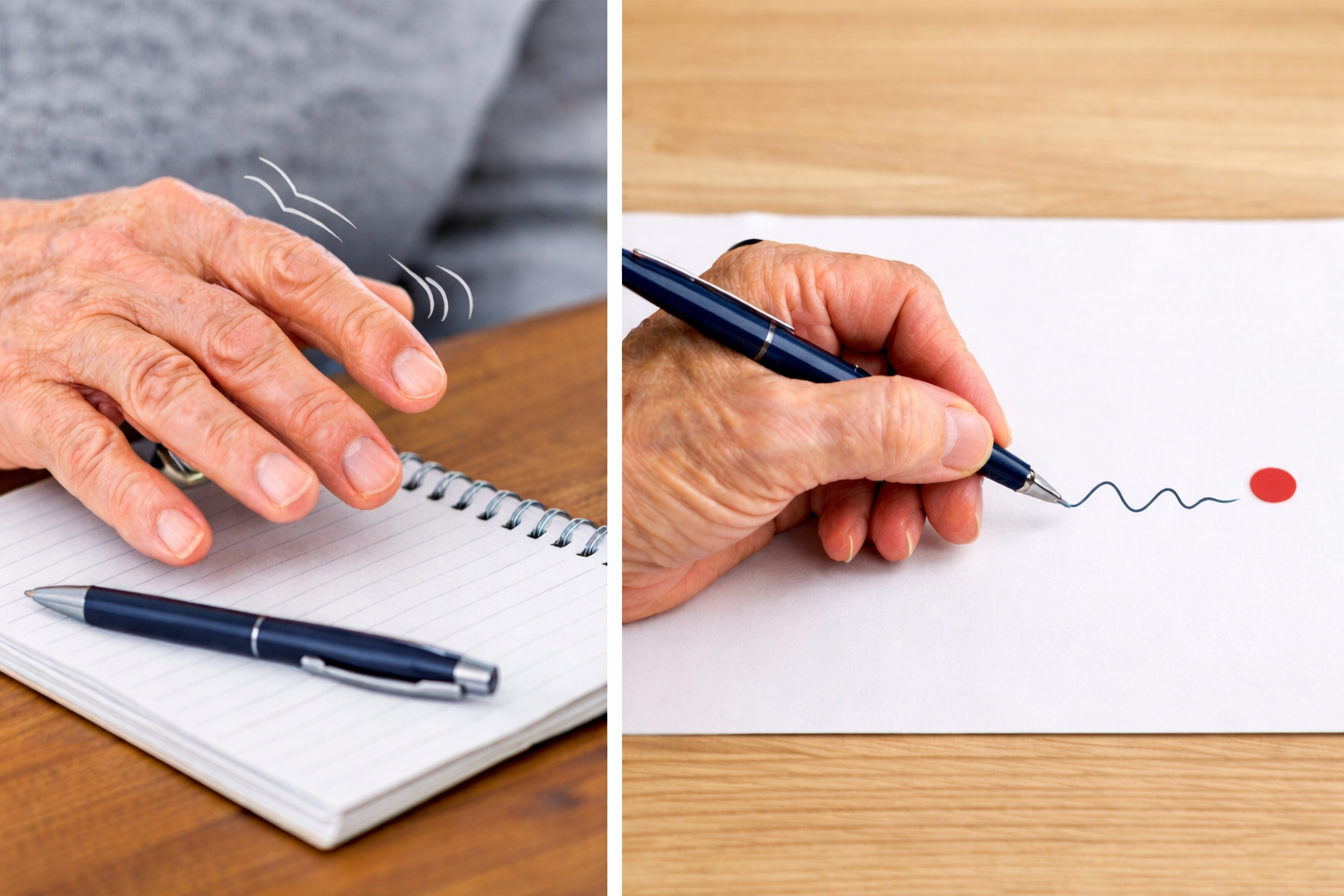
Intention tremor is a specific type of action tremor that appears—and becomes stronger—as you move toward a precise target. For example, the shaking might be minimal when your arm is at your side, but it gets much worse as you reach for a glass or try to touch your nose.
The shaking often gets worse at the very end of the movement, causing the hand to “zig-zag” or overshoot the target. This pattern usually points to an issue within the cerebellum, the part of the brain responsible for coordinating movement.

Common causes of intention tremor include:
-
Multiple sclerosis (MS)
-
Stroke or brain tumors
-
Traumatic head injury
-
Certain degenerative neurological diseases
People with intention tremor may also experience other signs of cerebellar dysfunction, such as an unsteady walk, slurred speech, or difficulty with tasks requiring fine coordination.
How Doctors Diagnose Intention vs. Essential Tremor
If you suspect you have an essential or intention tremor, a formal evaluation by a neurologist is the only way to get a definitive diagnosis. The process typically begins with a detailed clinical history. Your doctor will want to know the "backstory"—when the shaking first appeared, what triggers it, and whether anyone else in your family has similar symptoms.
During a physical exam, your doctor will observe your hands in four specific states:
-
At rest: To rule out Parkinson’s disease (which typically causes shaking when muscles are relaxed).
-
Maintaining a posture: Such as holding your arms outstretched in front of you.
-
During action: Performing tasks like writing, drawing spirals, or pouring water.
-
Coordination tests: The "finger-to-nose" test is the gold standard for identifying intention tremors. The doctor looks for whether the shaking worsens as your finger nears your face.
If your symptoms point toward a cerebellar issue (intention tremor), your doctor may request an MRI scan to check for structural changes, such as lesions from MS or a stroke. For essential tremor, diagnosis is usually clinical, though blood tests may be used to rule out metabolic triggers like thyroid issues.
Finding Relief: Treatment Options and Practical Solutions
There is no "one-size-fits-all" cure, but many people achieve meaningful improvement by combining medical care with practical strategies.
-
For Essential Tremor: Management often includes lifestyle changes (reducing caffeine and stress), occupational therapy, and medications like beta-blockers (propranolol) or anti-seizure drugs. In severe cases, advanced options like Deep Brain Stimulation (DBS) or focused ultrasound may be considered. You can find more information about essential tremor treatment and management methods in our blog: Treatment & Lifestyle.
-
For Intention Tremor: Treatment focuses on the underlying cause (e.g., managing MS or stroke rehabilitation). Physical therapy is crucial here to help "re-train" the brain and improve balance and coordination.
Making Your Day-to-Day a Little Easier
Living with a tremor means redesigning small moments to maintain your freedom:
-
Use weighted tools: Weighted cutlery and pens can provide enough stability to dampen fine tremors.
-
Simplify movements: Use two hands for drinking, choose cups with lids, or rest your elbows on a table while eating to provide a "pivot point" for stability.
-
Adaptive Tech: Voice-to-text software and smart home devices can reduce the frustration of interacting with small buttons or touchscreens.
A Modern Solution: The VILIM ball
If you are looking for a non-drug option to manage shaky hands, the VILIM ball offers a next-generation approach. It is a non-invasive, CE-marked handheld medical device specifically developed to reduce hand tremors using advanced AI technology.
The device works by providing localized, therapeutic mechanical vibrations to the muscles and nerves of the hand. Its smart algorithms analyze each user's specific tremor pattern to personalize the therapy. By using the VILIM ball for just 10 minutes before tasks like eating or writing, most users notice a visible improvement in hand steadiness, helping them regain control over their daily activities.

When to See a Doctor
While tremors are often manageable, you should seek medical attention if:
-
The tremor is brand new or progresses rapidly.
-
The shaking occurs primarily at rest.
-
It is accompanied by "red flags" like sudden weakness, slurred speech, vision changes, or a loss of balance.
Key Takeaways: Essential Tremor vs. Intention Tremor
Understanding your tremor is the first step toward regaining control. While essential tremor is typically a rhythmic shaking that occurs during any voluntary movement or posture, intention tremor specifically worsens as you reach for a precise target.
Because these symptoms stem from different causes—ranging from genetics to neurological conditions—a professional diagnosis by a neurologist is vital. Managing a tremor is most effective through a holistic approach, combining lifestyle adjustments, practical strategies, and supportive technology like the VILIM ball to help you maintain your independence.
Share: